


Understanding the Mind-Body Loop: A Path to Clarity and Success
- SURBHI TAYLIA

- May 22
- 8 min read
Updated: Jun 3
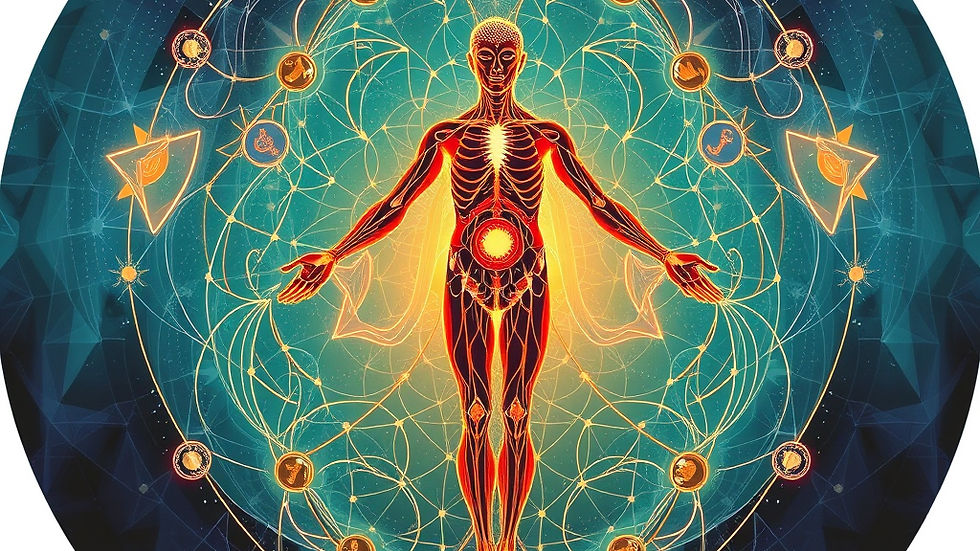
Assume for a moment the physical posture you typically hold when you are feeling your lowest — the shoulders, the head, the chest, the belly. Now ask: what thought arises naturally in this posture? What does the body, in this configuration, make the mind believe? That automatic thought is the loop in action.
Here is something the conventional mental health field has been slow to fully absorb, though the evidence has been building for decades: your thought patterns are not just mental events. They are physical events — encoded in your posture, your breath, your muscle tension, and your hormonal landscape. The body, once it has encoded a thought pattern as a physical state, will generate the matching thought — unprompted, automatically, repeatedly — simply by assuming the associated physical posture. The mind creates the body. The body then creates the mind. This is the loop. Until you address both ends, you are only solving half the problem.
The Laboratory That Proved It
In 2010, social psychologist Amy Cuddy ran a study at Harvard that produced findings more significant than she perhaps intended. Participants who held 'high-power' physical postures for two minutes showed measurably different hormonal profiles — higher testosterone, lower cortisol — than those who held 'low-power' postures for the same duration. The mind had not been addressed at all. Only the body. Yet, the mental and emotional state had changed anyway. This was not a discovery; ancient healing traditions had known it for millennia. Ayurveda's understanding of the body-mind as a single integrated system — not two separate entities that happen to be housed together — preceded this research by thousands of years. What the research added was the laboratory confirmation that most Western medicine still required. The body is not a vehicle for the mind. They are one system. Healing one without the other is, at best, incomplete.
Research published in Psychological Science found that physical posture directly influences confidence, decision-making, and anxiety levels independent of conscious thought. A 2022 meta-analysis in the Journal of Experimental Psychology confirmed that body-based interventions produce statistically significant changes in affect, cognition, and behavior — confirming the bidirectional body-mind relationship. Bessel van der Kolk's foundational work in The Body Keeps the Score established that trauma and chronic negative thought patterns are stored in the body's tissues and can only be fully released through body-level intervention.
The body keeps the score. It will always keep the score. The question is whether you are reading it.
BESSEL VAN DER KOLK — THE BODY KEEPS THE SCORE

The 7 Patterns of the Mind-Body Loop
Understanding the patterns that form the mind-body loop is crucial for breaking free from negative cycles. Here are seven key patterns to consider:
Pattern 1 — The Collapse Pattern
Defeat posture creating defeat thought.
Shoulders forward, chest closed, head downward — the body configuration of defeat, shame, and low self-worth. Research confirms this posture measurably increases cortisol and reduces testosterone within two minutes of its assumption. Because the body has associated this posture with these mental states across years of repetition, assuming it automatically generates the corresponding thought: I am not capable, I am not worthy, something is wrong with me. Breaking this loop requires conscious, repeated adoption of the opposite posture — even when it feels dishonest.
Pattern 2 — The Breath Hold Pattern
Shallow breath maintaining anxiety state.
Chronic anxiety is associated with a specific breathing pattern: shallow, rapid, upper-chest breathing that maintains the sympathetic nervous system in mild activation continuously. The mind registers this breath pattern as a signal that threat is ongoing — and generates anxiety thoughts in response. The loop is self-sustaining. Breaking it requires extended exhale breathing (physiologically activating parasympathetic response) practiced at intervals throughout the day, before the breath pattern activates the anxiety response.
Pattern 3 — The Jaw-Clenching Pattern
Suppressed speech creating suppressed self.
Chronic jaw clenching and throat tension are associated with suppressed expression — things felt but not said, boundaries not communicated, authentic self not expressed. The Ayurvedic understanding of Vishuddha (throat chakra) as the center of authentic expression maps precisely onto this somatic pattern. The body maintains the tension of suppression as a holding pattern. It also generates the corresponding thought: I cannot speak my truth. Breaking this loop requires both the somatic release (specific jaw-releasing exercises, humming, singing) and the communication practice.
Pattern 4 — The Tightened Belly Pattern
Chronic gut tension generating fear and dread.
The enteric nervous system — 500 million neurons in the gut — is exquisitely sensitive to threat. Chronic stress creates sustained gut tension that, once established as a default body state, generates low-level dread and anxiety as part of its normal operation. Most people with chronic anxiety have never noticed that the anxiety has a distinct physical precursor — the belly tightening before the thought arrives. Addressing the gut tension directly (abdominal breathing, specific yoga poses, digestive support) interrupts the loop at its physical origin.
Pattern 5 — The Frozen Shoulders Pattern
Carried responsibility creating mental burden.
Chronically elevated, tense shoulders are associated with the physical and mental experience of carrying too much responsibility — of being perpetually braced for the next demand, the next requirement, the next thing that needs to be held. The mind, registering this posture, generates thoughts of obligation, overwhelm, and the impossibility of rest. Breaking the loop: specific shoulder-releasing practices (rolling, stretching, Abhyanga — self-massage — on the shoulder and neck region) combined with the conscious practice of asking: What am I carrying that is not actually mine?
Pattern 6 — The Hypervigilance Pattern
Scanning eyes and tense listening creating threat.
In people who grew up in unpredictable or threatening environments, the eyes and ears are permanently calibrated for threat detection — a narrow, scanning attention that is constantly checking the periphery for danger. This physical orientation continuously generates threat-detection thoughts, even in environments that are objectively safe. Breaking this loop requires both conscious eye-softening practices (widening peripheral vision deliberately) and repeated experience of safety — the accumulated evidence that the current environment does not require the vigilance of the past one.
Pattern 7 — The Braced Core Pattern
Perpetual readiness creating perpetual anxiety.
A chronically braced abdominal core is associated with the body's readiness for impact — physical or emotional. It represents an anticipatory protective response that has become so habitual it is no longer consciously felt. The mind, registering this constant state of readiness, interprets it as evidence that impact is ongoing or imminent — generating anxious, anticipatory thought. Progressive muscular relaxation — specifically releasing the abdominal muscles, the pelvic floor, and the internal rotators of the hips — produces measurable reduction in anxiety markers within a single practice session.
Real-Life Example: Serena Williams
Serena Williams is, by virtually every measure, the greatest tennis player in history. She is also one of the most publicly documented cases of the mind-body loop in high-performance sport — both when it works against a person and when they learn to consciously reverse it.
In multiple interviews and in her autobiography, Williams has described the specific physical rituals she developed to interrupt the downward spiral that affects even the most elite athletes. The moment when a missed shot creates a physical collapse — the dropped shoulders, the shortened breath, the head downward — feeds back to the mind as confirmation that things are falling apart. This creates another missed shot, which deepens the collapse.
"I learned to never let my body show defeat," she told reporters after a career-defining comeback at the 2003 US Open. "Even when I was losing, I would stand upright. I would breathe deeply. I would look at the opponent directly. And I found that my mind would follow my body's lead."
This is the mind-body loop reversed deliberately and under the most high-pressure conditions available. Williams did not wait to feel confident before assuming a confident posture. She assumed the posture first — knowing, from years of experience, that the feeling would follow.
Her specific practice included bouncing on the balls of her feet between points (activating the parasympathetic nervous system), taking deep deliberate breaths visible from the stands, and maintaining an upright spine regardless of score. Each of these physical interventions directly counteracted the body states that generate defeat thoughts. She was not pretending. She was writing a different program — in the body first, because that is where programs are written.
↑ HOW THIS CASE STUDY ILLUSTRATES THE BLOG ABOVE — SAME PRINCIPLES, LIVED OUT AT THE HIGHEST LEVEL OF HUMAN ACHIEVEMENT.
You cannot think your way out of a posture that your body has made automatic. But you can will your way out of it — deliberately, repeatedly, until the body writes a new default.
Surbhi Taylia
Integrating Mind Wellness into Daily Life
The mind-body loop is the most direct evidence available that Body Wellness (Pillar 1) and Mind Wellness (Pillar 2) cannot be separated. The body creates the mind that the mind then reinforces in the body. Breaking this loop requires holistic intervention — and it is one of the central reasons the iSoul approach always addresses all three pillars simultaneously. A change in the body without a change in the mind will not last. A change in the mind without a change in the body will not land.
5 Mind Wellness Tools to Implement Daily
The Posture Intervention
Set an alarm for mid-morning and mid-afternoon. When it sounds, spend 60 seconds deliberately adopting the physical opposite of your default low state: open chest, elevated chin, relaxed shoulders, full belly breath. This is not performance. It is a signal to the nervous system that the threat state is not required. Two minutes daily, consistently, produces measurable hormonal and cognitive change within three weeks.
Extended Exhale Throughout the Day
Every time you notice a negative thought loop beginning, take one extended exhale — out for eight full counts — before engaging with the thought. This single intervention interrupts the breath-thought feedback loop at its physiological root. It takes approximately four seconds and can be done anywhere.
The Shoulder Audit
Once a day, notice the state of your shoulders without trying to change them. Are they elevated? Forward? Braced? Simply noticing is the first intervention. Then, deliberately, with full attention, roll them back and down and hold the release for 60 seconds. Name the thought that arises in the released position. Over weeks, this practice reveals the specific mental content stored in this physical holding.
Abdominal Breathing Before Any Stressful Event
Five full belly breaths — allowing the abdomen to expand outward on the inhale and release completely on the exhale — before any anticipated challenge. This deactivates the braced core pattern and its associated anxiety thought-generation before the event begins.
Body-First Response to Recurring Thoughts
The next time a recurring negative thought arrives, instead of addressing it cognitively, address it physically first. Where does it land in the body? What movement or breath does the body want in response? Allow the physical response before engaging the thought. Over time, this breaks the loop at the body end — which is, for most persistent patterns, the more durable intervention.
Release the Stored Patterns Now and Free the Body and In Turn Your Life
The mind-body loop is the mechanism behind the patterns that do not change despite years of cognitive work. At iSoul with Surbhi, we address Mind Wellness — Pillar 2 — in the context of the body it lives in and the soul it is serving. This is the work that changes what has not changed before. Book a session at isoulwithsurbhi.com.

Comments