


Stop Managing Anxiety. Start Addressing It.

Updated: Mar 24
The wound is the place where the light enters you.-Rumi

Her name was Priya. Forty-one years old. A senior manager in London, a mother of two, a woman who by every external measure had built a beautiful life. She described her anxiety the way most people do — as an adversary. Something that arrived uninvited and refused to leave. Something she had been fighting, medicating, outsmarting, and outrunning for nine years.
In our third session I said something that stopped her completely: "you've tried everything. The only thing you haven't tried is actually listening to it."
That sentence changed the direction of our work entirely. Because she felt I was right. And because that one shift — from fighting anxiety to understanding it — is the thing that nine years of management had never offered her.
This is what I want to explore with you today. Not how to suppress anxiety. Not how to cope with it. But what it is actually trying to say — and three specific, ancient, body-based tools with proven results that can help you finally hear it.
Between stimulus and response there is a space. In that space is our power to choose our response. In our response lies our growth and our freedom. — VIKTOR FRANKL
A Global Crisis — And a Global Misunderstanding

The World Health Organisation estimates that 301 million people worldwide currently live with an anxiety disorder — making it the most prevalent mental health condition on the planet. In the United Kingdom, one in six adults reports experiencing anxiety or depression in any given week. In India, the National Mental Health Survey found anxiety disorders to be among the most common conditions across all age groups. In Australia, beyond blue reports that over two million people are living with anxiety right now. Across Japan, Brazil, South Africa, Canada — the figures tell the same story. Anxiety does not belong to one country or one culture. It is a profoundly human experience of our time.
And yet the global conversation about anxiety — in clinical settings, in workplaces, in families — continues to treat it almost exclusively as a malfunction. A glitch in the system. Something to be corrected, reduced, managed, or numbed. We have built an entire industry around helping people avoid their anxiety more efficiently. We have not asked what the anxiety is for.
But what if anxiety is not a glitch? What if it is a signal?
In the Ayurvedic tradition, anxiety is understood as an excess of Vata — the air element — in the nervous system. Too much movement, too much thought, too much living in the future and the past simultaneously. The body registers this imbalance and responds with urgency: something is wrong, something needs attention, something is out of alignment. From this lens, anxiety is not the problem. It is the messenger. And we have been shooting the messenger for decades.
The Vedic Teaching That Changes Everything

There is a concept in Vedic philosophy called Prajna-aparadha — translated as "the mistake of the intellect." It describes what happens when the mind separates itself from the body and the deeper intelligence of the soul, and begins to operate purely from thought, fear, and conditioning.
This separation — mind severed from body, the thinking self estranged from the feeling self — is considered in Ayurveda to be the root cause of most suffering. And anxiety, in this framework, is one of its most consistent symptoms. Not because you are broken. But because some part of you has been living too much in the head and too little in the wholeness of what you are.
Western neuroscience is reaching the same conclusion from a different direction. The amygdala — the brain's threat-detection centre — cannot distinguish between a physical danger and an emotional or existential one. It fires the same alarm for a tiger in the room as it does for a difficult conversation you are dreading, a financial worry you have been avoiding, a version of yourself you are afraid to become. The alarm is real. The interpretation of what is threatening — that is where the work lives.
Priya had been managing her anxiety at the level of thought for nine years — reframing, rationalising, replacing negative thoughts with positive ones. Brilliant strategies, all of them. But the anxiety kept returning because it was not living in her thoughts. It was living in her body. In the tightness she felt every morning before her commute. In the jaw she held rigid through every performance review. In the way she hadn't fully exhaled — really exhaled, the kind that empties you completely — in longer than she could remember. The body had been sending messages. She had been answering them with her mind. They were speaking entirely different languages.
Your task is not to seek for love, but merely to seek and find all the barriers within yourself that you have built against it. Rumi
Three Roots of Anxiety
Before the practices, here is a framework that has guided the work I do with people across the world. When anxiety arrives, instead of asking how do I make this stop — ask: what is this trying to protect me from? Almost without exception, the answer traces to one of three roots:
Unprocessed truth. Something you know — about a relationship, a career, a direction your life is moving in — that you have not yet been willing to fully acknowledge. The anxiety is the pressure of that truth trying to surface through every available crack.
An unmet need for safety. Often rooted in early experience, in environments where the world did not feel predictable or secure. The nervous system learned to run constant threat-assessment — and has simply never been shown that it is safe to stop.
The gap between who you are and how you are living. When the life we are inhabiting is significantly out of alignment with the values, the callings, and the relationships that our soul recognises as true — the anxiety is the soul's insistence: this is not the right direction. Pay attention now, before the cost grows larger.
None of these can be resolved by thinking harder. All of them require the breath, the body, and a quality of honest self-witnessing that the ancient practices were specifically designed for. Here are the three I return to most consistently — with clients in Mumbai, in New York, in Nairobi, in Sydney. They work because they address what anxiety actually is, rather than what we have been told it is.
Three-Pillar Practice: Meeting Anxiety at Its Root
These three practices work on three different levels — the breath and nervous system, the body's stored tension, and the conscious mind's relationship with anxiety. Used consistently over 21 days, they do not suppress. They teach anxiety that it has been genuinely heard. And anxiety, when it feels heard, almost always begins to quiet.
PILLAR 1 · MUDRA + BREATHWORK
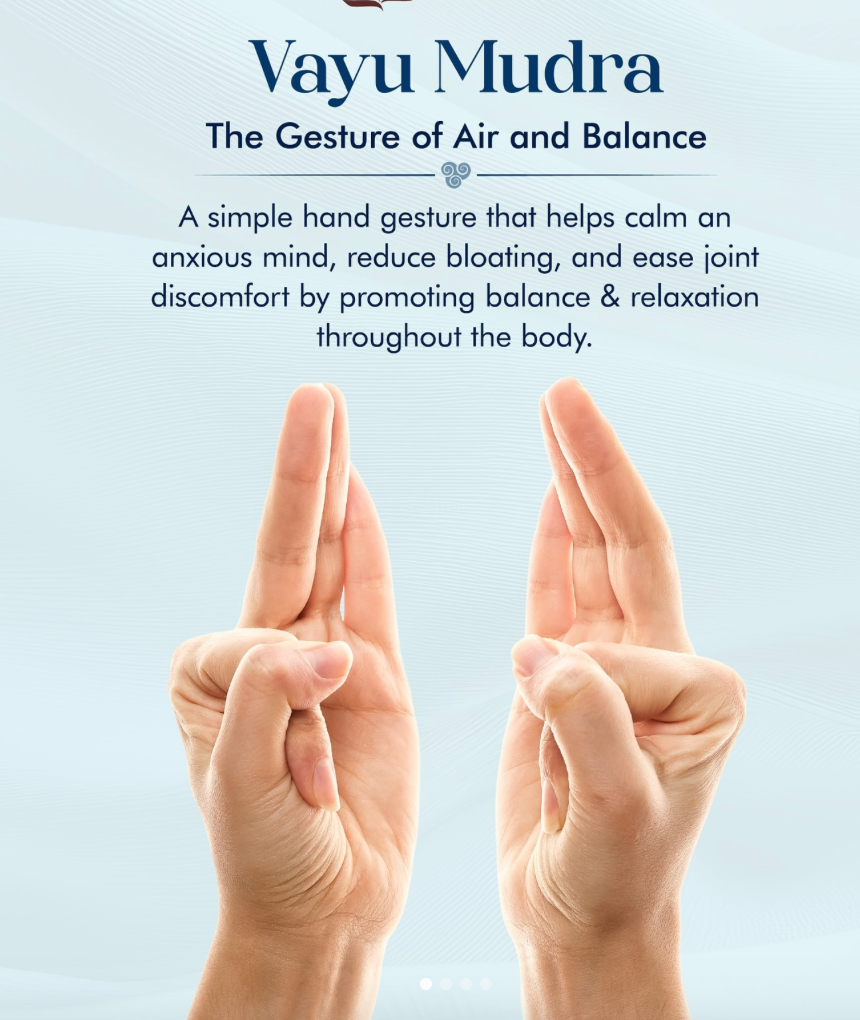
Vayu Mudra: Fold your index finger to the base of your thumb, press thumb gently over it, remaining fingers extended. Hold on both hands, palms on thighs. This specific mudra calms excess Vata — the Ayurvedic root of anxiety — and has been used for this purpose for over 3,000 years.
Box Breathing (immediate relief): Inhale 4 counts → hold 4 → exhale 4 → hold 4. Repeat 4 cycles. Used by military special forces globally to reset the nervous system under extreme stress. Clinical research confirms measurable cortisol reduction within 4 minutes.
Nadi Shodhana (alternate nostril, for daily practice): Close right nostril with thumb, inhale left 6 counts. Close both briefly. Open right, exhale 6. Inhale right 6. Close both. Exhale left 6. This is one cycle. Do 8 cycles each morning. Research from the International Journal of Yoga confirms significant reduction in anxiety scores after 6 weeks of daily practice. This breath balances the two hemispheres of the brain — the exact imbalance that chronic anxiety creates.
PILLAR 2 · RESTORATIVE PRACTICE

Constructive Rest Pose — The Psoas Release
Lie on your back, knees bent, feet flat on the floor hip-width apart. Let your knees fall gently inward. Arms open at your sides, palms up. Eyes closed.
This position — called Constructive Rest in somatic therapy — is the only position in which the psoas muscle can fully release. The psoas is the body's primary fight-or-flight muscle: it contracts during every threat response and, in chronically anxious people, is in a near-permanent state of contraction. This is the physical source of the tight belly, the compressed lower back, the feeling of being constantly braced for impact.
Stay for 15 minutes. No music. No phone. Just the floor and the breath and the slow, involuntary unwinding that begins when the body finally believes it is safe. Many people feel the anxiety physically drain from their hips and lower back within 8 minutes. That is not imagination — that is the psoas completing a discharge it has been holding for months, sometimes years.
PILLAR 3 · THE DIALOGUE JOURNAL

This is the practice that changed everything for Priya — and for dozens of people I have worked with across different countries and cultures.
Open your journal. Write at the top: "Dear Anxiety — I am ready to listen. What are you trying to tell me?" Then write its answer. Not what your thinking mind says. What arises from the felt sense beneath the thoughts — the place that knows things before the mind has formed them into language.
Let it speak without editing or judgment. Then write back: "I hear you. What do you need from me right now?"
Do this for 15 minutes, three times a week. Within three weeks, most people discover their anxiety has been repeating the same two or three things — things that, once genuinely heard, are entirely addressable. The anxiety was never the enemy. It was the most persistent, most loyal part of you — trying to get your attention by any means necessary.
Priya, Nine Months Later....
I want to close by finishing Priya's story — because I think it is the most honest thing I can offer you.
She did not cure her anxiety in nine months. That is not how this works, and I would not insult you by suggesting otherwise. What happened was something different — and, I believe, far more valuable. She stopped being at war with herself.
The anxiety still visits. But now when it arrives, she meets it differently. With the Vayu mudra held quietly during her morning commute. With fifteen minutes on the floor with her knees bent before the children wake. With the journal open on Sunday evenings and the question asked with genuine curiosity: what are you trying to tell me this week? And it tells her. Usually something true. Something she needed to hear.
In her last message to me she wrote something I carry with me still: "I don't think I want to manage the anxiety anymore. I think I want to understand it. It turns out it has been looking out for me all along. I just never knew how to hear it."
That is the shift. Not from anxious to not-anxious. From stranger to self. From fighting to listening. It begins — always — with the willingness to stop long enough to hear what has been trying, for so long, to reach you.
If anxiety has been running your life and you are ready to understand it rather than just survive it — I offer one-on-one sessions designed to meet you at the root. Come exactly as you are.
I would highly recommend to book a session with Target Therapy if you have been dealing with anxiety, stress, OCD or any other form of mental destress . Using years of experience I combine ancient techniques to give you a lifetime tool for becoming your happiest self and leave the worries behind you for good.


Comments